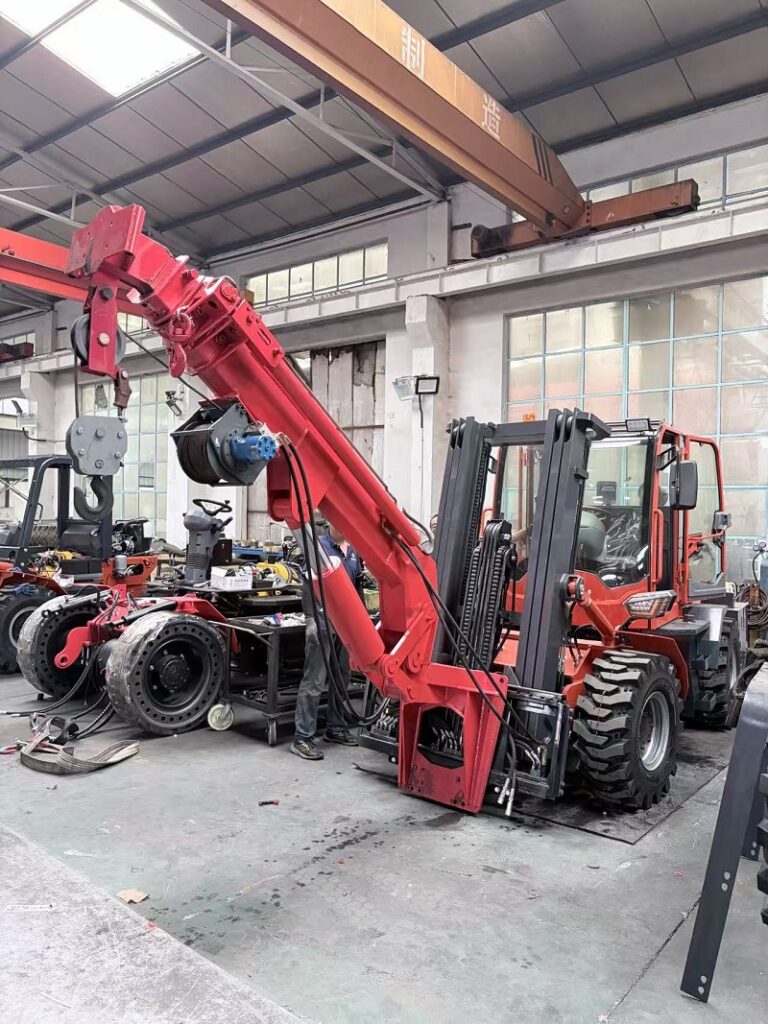
Landtiger35 4WD rough terrain forklift fly jib installation
A forklift can become a very different machine when a crane jib is added.
These photos show our team installing a 6.6m forklift fly jib with a winch on a Kaystar Landtiger35 4WD rough terrain forklift. The Landtiger35 is a 3.5-ton 4x4 forklift designed for outdoor construction and material handling, and the fly jib gives it another way to handle suspended loads.
The fly jib has a length of 2.8 metres when retracted and reaches 6.6 metres when fully extended. Its rated load is 3 tons at the shorter boom position and 600 kg when fully extended to 6.6 metres. These figures are based on the jib configuration and must be considered together with the actual forklift capacity and working conditions.
Installing the fly jib on a rough terrain forklift
The jib is mounted on the forklift and connected to the carriage. In this case, the machine is our Landtiger35, a 3.5-ton 4WD rough terrain forklift.
The installation is carried out by our technicians at the factory. Before the machine is put into operation, the mounting points, boom position, hydraulic or mechanical connections and overall clearance need to be checked.
The photos also show the additional winch installed on the fly jib. This configuration uses a 20-metre steel wire rope, giving the operator more flexibility when lifting loads from below or positioning materials at a distance from the forklift.
This is one reason customers choose a fly jib instead of using the standard forks for every lifting job. The forklift can approach the working area while the jib and winch provide a separate lifting point for suspended loads.
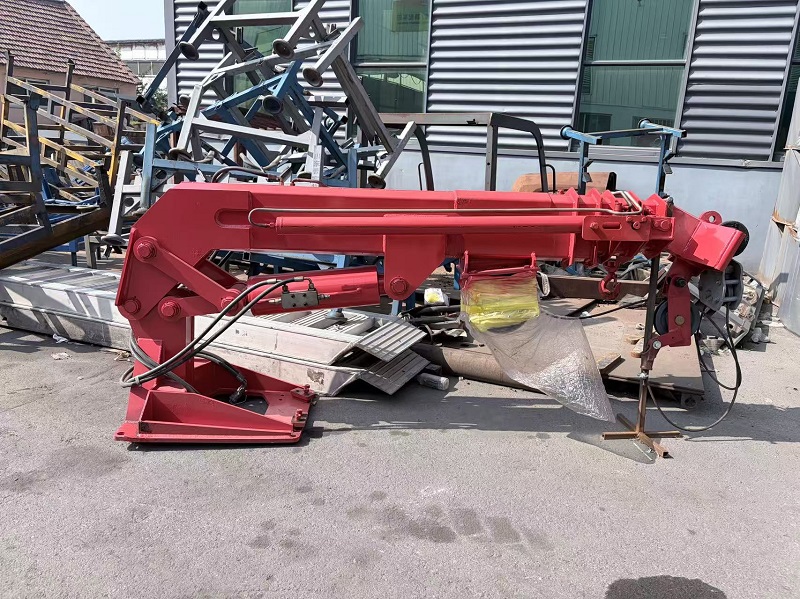
6.6m forklift fly jib with winch and steel cable
6.6 metres of reach
The fly jib is made with several boom sections. When fully retracted, the boom is approximately 2.8 metres long. After the sections are extended, the total length reaches approximately 6.6 metres.
At the shorter boom position, the rated load is up to 3,000 kg. At the maximum 6.6-metre extension, the rated load is 600 kg.
This difference is important when selecting a forklift jib. The longer the boom is extended, the farther the load moves away from the forklift, and the allowable lifting capacity changes accordingly.
The name “4-ton forklift fly jib” refers to the forklift class and application of this jib. It does not mean that the machine can lift four tons at the full 6.6-metre extension.
Fly jib and winch combination
With the winch and 20m steel cable installed, the fly jib becomes more useful for lifting loads that cannot easily be handled on forklift forks.
Typical applications include lifting construction materials, machinery parts, steel components, pipes, equipment and other suspended loads.
The winch also makes it possible to lower or raise the load vertically while the forklift remains in position. For construction sites and outdoor projects, this can be useful when the load needs to be positioned below the level of the forklift or moved into a location that is difficult to reach with forks.
A work platform can also be used with suitable fly jib configurations. On our standard 6.6m model, the work platform and winch are optional attachments. For this particular Landtiger35, the customer has chosen the winch and 20m steel cable configuration.
Why install it on a 4WD rough terrain forklift?
The combination of a fly jib and a 4WD rough terrain forklift is particularly suitable for outdoor work.
The Landtiger35 uses four-wheel drive and is designed for construction sites, building projects, yards and other areas where the ground conditions are not always suitable for a standard warehouse forklift.
As a forklift manufacturer, we can also check the attachment together with the base machine rather than treating the jib as a completely separate product.
For customers who already operate a Landtiger35 or another suitable rough terrain forklift, we can discuss the required boom length, lifting capacity, winch configuration and other attachment options according to the actual application.
A forklift with more than one job
The main advantage of a forklift fly jib is flexibility.
The same rough terrain forklift can be used for normal fork handling work and, when the appropriate attachment is installed, for lifting suspended loads. This is especially useful for contractors who do not need a dedicated mobile crane for every small lifting job but still need a longer reach than standard forks can provide.
Our 6.6m forklift fly jib is suitable for 3-ton, 4-ton and 5-ton forklift applications, including Kaystar 4WD all-terrain forklifts. The exact configuration should always be matched to the forklift's rated capacity, load centre and working conditions.
For a project requiring a forklift crane jib with winch, send us your forklift model, required boom length and approximate load. We can check the suitable configuration and provide the fly jib together with the corresponding attachment options.
Kaystar manufactures 4WD rough terrain forklifts and forklift attachments, so we can also provide the complete combination of the forklift and fly jib for customers who need a ready-to-use solution.
 English
 Arabic
 French
 Latin
Latin Russian
 Spanish
 Thai
Thai